High-pressure filter press feed systems operating in coal processing, mineral tailings dewatering, and other abrasive slurry environments face a constant battle against material wear that can quickly degrade performance, increase maintenance frequency, and drive up total operational costs. Wear-resistant performance is not merely a desirable feature in these applications; it is a fundamental requirement for sustained, reliable operation over thousands of cycles. When internal components are not engineered to withstand the relentless impact and erosion caused by sharp, dense solid particles, the entire feeding system can experience a gradual but steady decline in flow capacity and pressure output, eventually failing to meet the demands of the filtration cycle and forcing unplanned downtime for repairs or replacement.
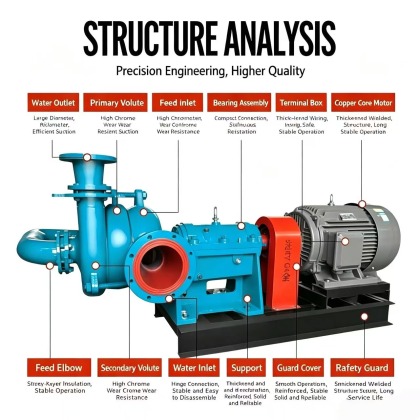
Effective wear management in a high-pressure feed system extends far beyond simply selecting harder materials. It involves a comprehensive approach that addresses hydraulic flow path design, material science, mechanical configuration, and practical maintenance access. The most reliable installations are those where every wetted component—from the inlet manifold to the final discharge valve—is purpose-built to handle the specific particle size distribution, solids concentration, and chemical composition of the slurry being processed. This level of targeted engineering is what separates a system that delivers years of consistent service from one that becomes a recurring source of operational headaches and budget overruns.
Flow Path Geometry and Its Direct Impact on Component Erosion
The geometry of the internal flow path within a high-pressure feed pump is the first and most critical line of defense against abrasive wear. Sharp bends, sudden changes in cross-sectional area, and poorly streamlined transitions create turbulent flow zones where solid particles are forced to change direction rapidly, slamming into metal surfaces at high velocity. Over time, these repeated impacts carve away material, gradually changing the internal clearances and disrupting the original hydraulic profile of the system. This erosion not only reduces efficiency but can also create uneven pressure distribution that leads to inconsistent filter cake formation.
Superior wear-resistant designs prioritize smooth, gradual flow transitions that minimize particle impact energy. Large-radius curves replace sharp elbows, tapered sections guide the slurry smoothly from one diameter to another, and internal contours are carefully calculated to maintain a consistent, streamlined flow profile from inlet to outlet. By eliminating high-turbulence zones, these geometries dramatically reduce the kinetic energy with which particles strike internal surfaces, fundamentally lowering the rate of material loss. The result is a system that maintains its original flow and pressure characteristics over a much longer service life, providing plant operators with predictable, repeatable performance across thousands of operating hours.
Material selection for these critical wetted components must align precisely with the specific abrasion mechanism at play. For slurries dominated by fine, hard particles that cause low-angle scratching and gouging, materials with high surface hardness and excellent compressive strength are typically chosen to resist penetration. For applications with larger, coarse particles that cause high-impact deformation, materials with high toughness and fatigue resistance are often preferred to absorb and dissipate impact energy without cracking or spalling. The most durable systems often employ a combination of materials and surface treatments, matching the optimal properties to the specific wear patterns expected in different sections of the flow path.
Material Science and Surface Engineering for Extended Service Life
Beyond basic metallurgy, advanced surface engineering techniques play a pivotal role in enhancing the wear resistance of critical components exposed to high-velocity abrasive slurries. Techniques such as high-velocity oxygen fuel (HVOF) thermal spraying, laser cladding, and diffusion-based hardening processes can apply extremely hard, dense coatings to base materials, creating a wear-resistant barrier that protects the underlying substrate. These coatings are often formulated from tungsten carbide, chromium carbide, or specialized ceramic composites, offering hardness levels far exceeding those of conventional cast or forged steels.
The application process is as important as the coating material itself. A poorly bonded coating will spall or delaminate under continuous particle bombardment, potentially creating debris that accelerates wear elsewhere in the system. Superior application methods ensure a metallurgical or mechanical bond with the substrate that can withstand the cyclic stresses of high-pressure operation, thermal expansion, and particle impact. The thickness and microstructure of the coating are also carefully controlled to provide optimal wear resistance without compromising the dimensional tolerances or mechanical integrity of the underlying component.
For components subject to both abrasion and corrosion—a common scenario in mineral processing with slightly acidic or alkaline slurry chemistries—material selection becomes even more complex. In these environments, standard high-hardness materials may suffer from accelerated wear due to corrosive attack that weakens the surface matrix. Dual-performance materials or composite structures that combine corrosion-resistant alloys with wear-resistant overlays are often employed. The goal is to create a component that resists both chemical dissolution and mechanical abrasion, ensuring long-term reliability in the harshest combined service conditions.
Mechanical Design Features that Minimize Wear and Simplify Maintenance
Wear-resistant performance is not solely determined by the materials in contact with the slurry; the overall mechanical design of the feed system plays an equally important role. Features that reduce internal fluid velocity, eliminate dead zones where solids can settle and cause accelerated localized wear, and protect critical sealing surfaces all contribute to a longer operational lifespan. For example, generously sized inlet manifolds and valve ports reduce slurry velocity at entry points, lowering the kinetic energy of particles before they reach more restrictive internal passages.
Seal and gland area protection is paramount in high-pressure abrasive service. Even minor abrasive particle ingress into a seal cavity can quickly destroy packing or mechanical seal faces, leading to leaks and pressure loss. Effective designs incorporate multiple stages of particle exclusion, such as flush ports, expeller vanes, or dedicated clean barrier fluid systems, to keep abrasive slurry away from the primary sealing elements. These features are not add-ons; they are integral to the core design philosophy of a system built for severe service.
Finally, a wear-resistant design must account for practical maintenance and part replacement. Components that are expected to wear—even at a greatly reduced rate—should be designed for straightforward inspection and replacement without requiring complete disassembly of the entire unit. Modular construction, standardized connection interfaces, and clear wear indicators allow maintenance teams to plan interventions during scheduled shutdowns, swap out worn parts efficiently, and return the system to service with minimal downtime. This design-for-maintenance approach transforms wear management from a reactive, costly burden into a predictable, planned component of overall plant operational strategy.

