Ⅰ Introduction to PON
PON stands for Passive Optical Network. It is a network technology based on Point-to-Multipoint (P2MP) topology. It is applied between the OLT (Optical Line Terminal) at the central office and multiple ONU/ONT (Optical Network Unit / Optical Network Terminal) at the user side. They are interconnected through the Optical Distribution Network (ODN), which consists of passive optical cables, optical splitters/combiners, and ODP (Optical Distribution Point).
ODP is a passive optical splitter. Its function is to split the downstream signal from the OLT into multiple identical output signals — it does not change signal content but only distributes optical power. Meanwhile, it aggregates upstream signals from ONTs and forwards them to the OLT. There are no active electronic devices in the ODN between OLT and ONU.
Main types of PON include:
APON: ATM-based passive optical access technology complies with the ITU-T G.983 series standards. APON and BPON fall into the same category and have been basically replaced by GPON.
EPON: Ethernet-based passive optical access technology complies with the IEEE 802.3ah series standards. It is suitable for carrying Ethernet-based services. Featuring simplicity, low cost and medium performance, it can meet the service demands of residential customers and has become the mainstream application at present. Its splitting ratio is within 1(2):32.
GPON: This ATM/GEM-based passive optical access technology complies with the ITU-T G.984 series standards. It provides full support for multi-service access. Though it comes with slightly higher complexity, it offers excellent integrity, performance and security, and can well meet the demands of integrated service access. As an upgraded version of APON, its maximum splitting ratio is up to 1:64.
Composition of PON
- OLT: Optical Line Terminal
- ONU: Optical Network Unit
- ONT: Optical Network Terminal
- ODN: Optical Distribution Network
PON Single-Fiber Bidirectional Transmission Mechanism
The PON system adopts WDM technology to realize single-fiber bidirectional transmission.

To separate the upstream and downstream signals of multiple users over the same optical fiber, two multiplexing technologies are adopted:
The downstream data stream adopts broadcast mode, while the upstream data stream uses TDMA (Time Division Multiple Access) technology.
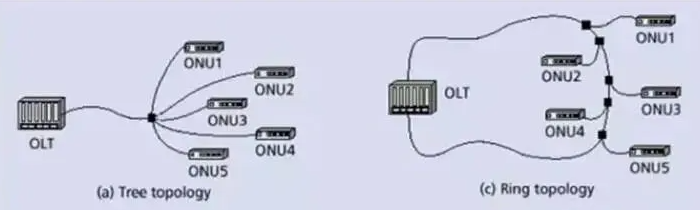
Common Networking Topologies of PON Systems:
Advantages of PON Technology
It features relatively low cost, simple maintenance, easy expandability and convenient upgradability. The PON structure requires no power supply during transmission and contains no electronic components. It is easy to deploy, barely needs maintenance, and delivers significant savings in long-term operation and management costs.
As a pure medium network, the Passive Optical Network completely avoids electromagnetic interference and lightning impacts, making it highly suitable for deployment in regions with harsh natural conditions.
The PON system occupies minimal resources at the central office, with low initial investment, easy expansion and a high return on investment.
It delivers extremely high bandwidth. Currently, EPON provides symmetric upstream and downstream bandwidth of 1.25 Gbps, and can be upgraded to 10 Gbps with the development of Ethernet technology. GPON offers a bandwidth of 2.5 Gbps.
It covers a wide service range. As a point-to-multipoint network, PON adopts a fan-out structure to save central office resources and serve a large number of users. Sharing central office equipment and optical fibers further reduces investment costs.
It supports flexible bandwidth allocation and guaranteed service quality. Both GPON and EPON systems adopt a complete set of mechanisms for bandwidth allocation and service assurance, enabling user-level SLA implementation.
Comparison of GPON / EPON / APON:
Same topology — P2MP optical fiber; different encapsulation protocols.
APON: Proposed by FSAN and standardized by ITU-T; adopts ATM encapsulation. It has the most comprehensive and mature standardization, yet it has not gained market recognition.
EPON: Standardized by the IEEE EFM Working Group under the standard number 802.3ah; adopts Ethernet encapsulation. Relevant domestic standards have been fully formulated, and its products have been rapidly applied in the market.
GPON: Proposed by FSAN and standardized by ITU-T as G.984.x series standards; supports ATM and GEM dual encapsulation. Its standards are fully completed, but only a very small number of manufacturers provide support.
Advantages of PON Technology
It features relatively low cost, simple maintenance, easy expandability and convenient upgradability. The PON structure requires no power supply during transmission and contains no electronic components. It is easy to deploy, barely needs maintenance, and delivers significant savings in long-term operation and management costs.
As a pure medium network, the Passive Optical Network completely avoids electromagnetic interference and lightning impacts, making it highly suitable for deployment in regions with harsh natural conditions.
The PON system occupies minimal resources at the central office, with low initial investment, easy expansion and a high return on investment.
It delivers extremely high bandwidth. Currently, EPON provides symmetric upstream and downstream bandwidth of 1.25 Gbps, and can be upgraded to 10 Gbps with the development of Ethernet technology. GPON offers a bandwidth of 2.5 Gbps.
It covers a wide service range. As a point-to-multipoint network, PON adopts a fan-out structure to save central office resources and serve a large number of users. Sharing central office equipment and optical fibers further reduces investment costs.
It supports flexible bandwidth allocation and guaranteed service quality. Both GPON and EPON systems adopt a complete set of mechanisms for bandwidth allocation and service assurance, enabling user-level SLA implementation.
Comparison of GPON / EPON / APON:
APON: Proposed by FSAN and standardized by ITU-T; adopts ATM encapsulation. It has the most comprehensive and mature standardization, yet it has not gained market recognition.
EPON: Standardized by the IEEE EFM Working Group under the standard number 802.3ah; adopts Ethernet encapsulation. Relevant domestic standards have been fully formulated, and its products have been rapidly applied in the market.
GPON: Proposed by FSAN and standardized by ITU-T as G.984.x series standards; supports ATM and GEM dual encapsulation. Its standards are fully completed, but only a very small number of manufacturers provide support.
Ⅱ Working Principle of FTTH
Definition: FTTH stands for Fiber to the Home. It refers to an access method that uses optical fibers to connect the communication central office to residential households. Among various broadband access technologies, FTTH represents the mainstream development trend of broadband access at present.
Composition of FTTH System
The basic components consist of three major parts: OLT, ODN and ONT.
Service Types Carried by FTTH
- IP data service
- Voice service: including POTS voice and VoIP services
- Video service: including interactive video service and broadcast video service, such as IPTV and CATV
Among them, IP data service and voice service are mandatory service types supported by FTTH, while video service support is optional.
Duplex Mode of FTTH Signal Transmission
Single-fiber Bidirectional Transmission:Two optical waves with opposite transmission directions and different wavelengths are transmitted over the same optical fiber. Each optical wave carries data flow in one direction, and the two waves work collaboratively to realize bidirectional data interaction.
Dual-fiber Bidirectional Transmission:Uplink and downlink signals are carried by two separate physical optical fibers respectively.
Technical Development of FTTH
Point-to-Point Optical Access Mode: Point-to-point Ethernet access; Community switch access
Point-to-Multipoint Optical Access Mode: APON, EPON, GPON
Working Principle of FTTx:
Analyzed from the perspective of frame structure and uplink/downlink control mode.
- Frame Structure of EPON:
Based on the IEEE 802.3 frame formatNewly added LLID: used to identify each ONU on the OLT side
2.Downstream of EPON: Broadcast mode
After an ONU completes dynamic registration, a unique LLID is assigned to it.
An LLID is added at the beginning of each packet, replacing the last two bytes of the Ethernet preamble.
When the OLT receives data, it compares the LLID with the registration list. When an ONU receives data, it only accepts frames that match its own LLID or broadcast frames.
3.EPON Uplink: TDMA mode、
Before receiving data, the OLT compares the LLID registration list.
Each ONU transmits data frames in time slots uniformly allocated by the central office equipment.
The allocated time slots compensate for the distance difference among various ONUs and avoid data collision between ONUs.
Ⅲ FTTH Transmission Indicators
Principles of ODN Optical Channel Attenuation
The allowable attenuation of the ODN optical channel is defined as the optical attenuation between the S/R and R/S reference points, expressed in dB. It consists of the total Insertion Loss (IL) introduced by optical fibers, optical splitters, fiber movable connectors and fiber fusion splices.
During the design process, the insertion loss shall be calculated between the OLT and the farthest ONU. The worst-case method is adopted for ODN optical channel attenuation calculation to meet the power budget requirements of the PON optical ports of OLT and ONU.
Calculation of ODN Optical Channel Attenuation
- Optical fiber attenuation value:0.36 dB/km at the wavelength of 1310 nm;0.22 dB/km at the wavelength of 1490 nm.
- Insertion loss of fiber movable connector: 0.5 dB/pair.
- Fusion splice attenuation value:Separate optical fiber splice: 0.08 dB per splice;Ribbon optical fiber splice: 0.2 dB per splice.
- Bidirectional average loss of mechanical splice: 0.15 dB per splice.
Ⅳ OLT / ONU Transmission Equipment

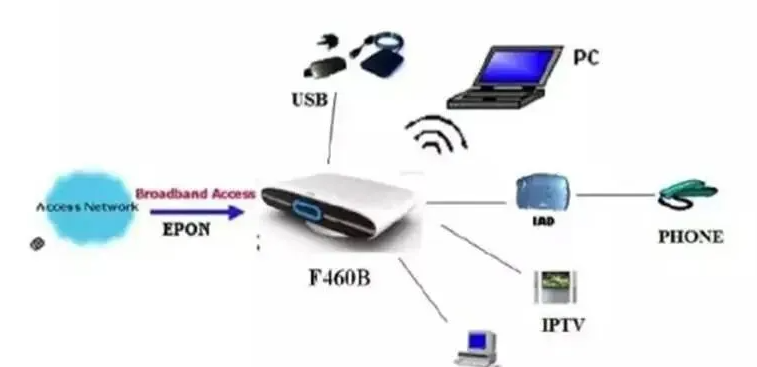
The ZXA10 F460B is an indoor optical network terminal in the product series. It cooperates with the OLT to implement FTTH applications.
With its multi-user interfaces, or by connecting with low-cost HUBs and Ethernet switches, the ZXA10 F460B can also support FTTO/B applications.
5.ODN Network Components
Composition of ODN
- Distribution Equipment (ODF)
- Cabinets (Optical Cross-Connect Cabinet, Fiber Distribution Box)
- ODN Related Optical Devices (Optical Splitter, etc.)
- ODN Related Optical Fibers and Cables
- ODN Related Splicing Technologies
Supporting Materials of ODN Network
Central Office Distribution Facilities:Optical Distribution Frame, etc.
Optical Distribution Point Facilities:Optical Distribution Frame, Optical Cross-Connect Cabinet, Optical Fiber Distribution Box, Optical Splitter, Optical Splice Closure
Optical User Access Point Facilities:Optical Splitter, Optical Fiber Distribution Box, Optical Terminal Box, Optical Splice Closure
Other Basic Materials:Optical Cable, Fiber Optic Connector, Pigtail, etc.
Ⅴ FTTH Engineering Interface
Division of Engineering Interface for FTTH Optical Cable Lines
New Residential Communities:
During the engineering phase: complete the layout and testing of distribution optical cables, the installation and testing of community optical cross-connect cabinets and optical splitters, the laying and testing of access optical cables, and the installation of corridor optical fiber distribution boxes.
Also complete the laying of drop optical cables, fusion splicing between drop optical cables and access optical cables inside distribution boxes, and red light testing of drop optical cables.
During equipment installation: complete the user-side termination of drop optical cables and equipment commissioning.
Renovated Residential Communities:
During the engineering phase: complete the layout and testing of distribution optical cables, the installation and testing of community optical cross-connect cabinets and primary optical splitters, the laying and testing of access optical cables, as well as the installation and testing of corridor optical distribution boxes and secondary optical splitters.
During equipment installation: complete the laying (including surface conduit and trunking layout), termination of drop optical cables, and equipment commissioning.
We Are Your Optical Supply Chain Navigator.In the complex world of optical communications, sourcing the right components should not be an obstacle. APEX was founded on a simple idea: to serve as a strategic bridge connecting world-class manufacturers with customers who urgently need a reliable and flexible supply chain. We are not a traditional distributor, but your dedicated supply chain partner, committed to simplifying procurement, securing supply, and making technical compatibility straightforward.
Official website address:https://www.apexallinone.com/

